Total Washout: Surf Arcade
- 4.7
- Rating
- 10.00K
- Installs
- Free
- Price
 Analysis by App-foxy
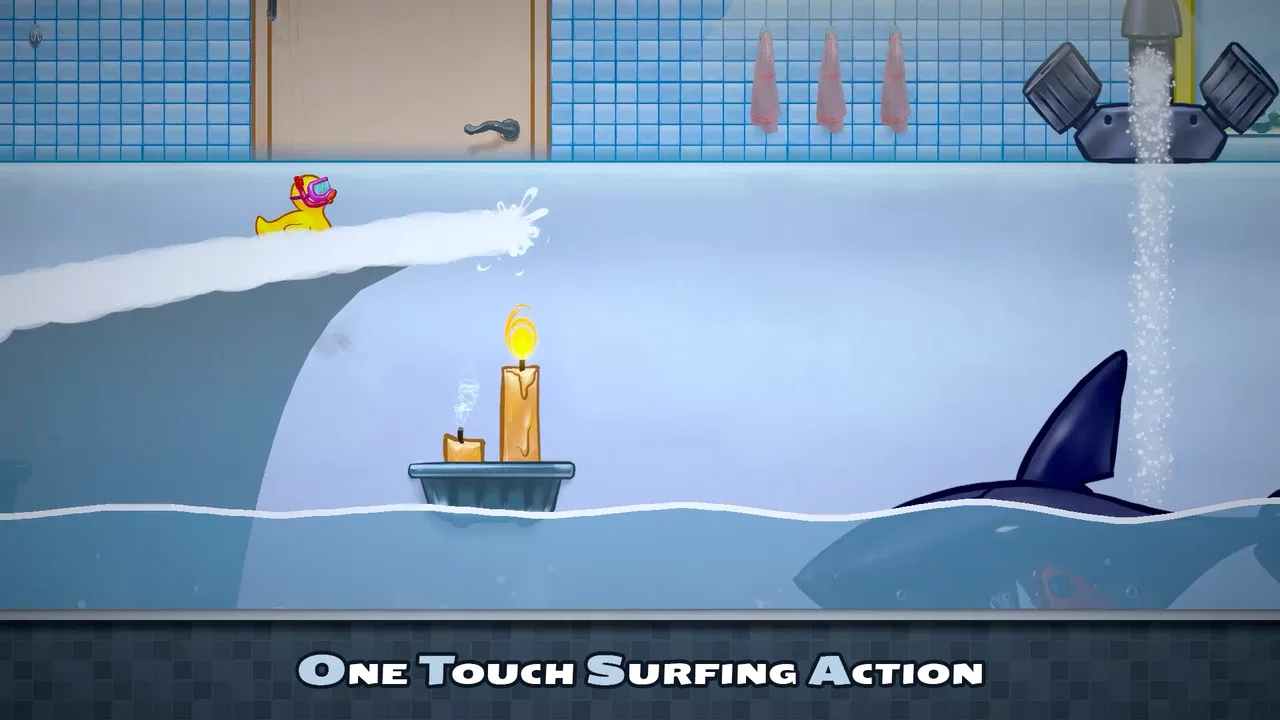
I went into Total Washout: Surf Arcade expecting a lightweight action game, and that is exactly where it works best: as a quick, visually silly challenge that asks me to draw, react, and recover before the screen becomes impossible to read. Its bathtub setting gives the game a playful identity, but the appeal comes from the way drawing and dodging are tied together. I am not simply steering a character through a fixed route; I am trying to shape a safe path while hazards keep demanding attention.
Developed by Super Smith Bros LTD, this free action game is aimed at Everyone and runs on devices using iOS 11 or later. The current version is 1.3.1, and the game has built a 4.7 average from around 243 ratings, with more than 10K installs. Those numbers suggest a small but enthusiastic audience rather than a massive mainstream release, which fits the experience: it feels like a focused arcade idea rather than a sprawling mobile production.
The basic pitch is easy to understand, but the moment-to-moment play has more going on than the store wording suggests. I draw waves, avoid laser sharks, and try to improve my performance as the action accelerates. The important distinction is that drawing is not just decoration. Every stroke is a decision about where I want movement to go and how much attention I can spare for the next threat. That makes even short attempts feel active instead of passive.
You May Also Like

 AccuWeather: Weather Radar
AccuWeather Review: A Quick, Clear Forecast for Everyday Decisions
For everyday plans, the best forecast is the one you can understand quickly. AccuWeather makes rain timing, radar, and local conditions easy to act on, with a few trade-offs.

 Hill Climb Racing
Why Hill Climb Racing Still Turns Crashes Into One More Run
A tiny car, a bumpy hill and one more upgrade: Hill Climb Racing keeps resurfacing because its simple chaos makes every near-miss feel personal.

 AliExpress - Shopping App
AliExpress Makes Global Shopping Feel Personal, but Shoppers Bear the Risk
AliExpress turns a global marketplace into a pocket-sized discovery engine. Its reach is useful, its shopping loop compelling, and its trade-offs easy to miss.

 Lords Mobile: Kingdom Wars
Lords Mobile Is a Kingdom-Building Routine, Not a Quick Match
A case-by-case verdict on the building, battles, device demands, and social commitments that make Lords Mobile rewarding for some players and exhausting for others.

 PDF Scanner app - TapScanner
TapScanner Makes Paperwork Easier to Capture, Check, and Share
TapScanner makes scanning with a phone feel less like a rescue operation and more like a dependable step in getting work done. Its capture tools are useful, though not flawless.

 Block Blast!
 Shows How Much a Puzzle Game Can Leave Out
A quiet grid game shows why puzzle players increasingly value instant clarity, repeatable skill and low-pressure play—and where the genre still needs to catch up.
More From Our News Desk
View All News


How a normal run feels from the first swipe
My usual workflow starts with a deliberately cautious opening. I do not immediately make ambitious shapes or swipe across the whole screen. I first watch how the current space behaves, identify where the immediate danger is coming from, and make a short movement that leaves room for correction. That habit matters because a large first gesture can solve one problem while creating another: it may move me away from a laser but put me directly in the path of the next hazard.
The bathtub theme gives the action a friendly surface, yet the game is not relaxing once several threats overlap. The contrast is part of the charm. Bright, amusing hazards are easier to approach than a grim action setting, but they still punish careless movement. I found myself laughing at the presentation during early attempts and then concentrating hard a few moments later when a familiar pattern became faster.
A useful everyday scenario is a short break between tasks. I can play a run while waiting for a download, sitting on public transport, or taking a few minutes away from work. The game does not require me to commit to a long campaign session before I see whether I am improving. I can make one attempt, notice the mistake that ended it, and try again with a specific adjustment. That repeatable loop is one of its strongest qualities.
The first practical question for many players is whether the game feels suitable for casual use. In my experience, yes, but with an important qualification: it is casual in session length, not always in concentration. A run may be easy to start, yet surviving later action requires attention. Someone looking for a background game that can be played while watching something else will probably find the visual demands too high. Someone who enjoys quick arcade tests should settle in quickly.
The small habit that makes early attempts cleaner
I get better results when I treat each drawing gesture as a controlled correction rather than a permanent plan. Shorter strokes are easier to evaluate, especially when the screen is becoming crowded. After a move, I pause mentally for a fraction of a second and check whether the new position is actually safer. This prevents the common mistake of continuing to draw simply because the first gesture felt successful.
That approach also helps separate two kinds of failure. Sometimes I choose the wrong direction; other times I react correctly but react too late. Those are different problems, and repeating the same gesture will not solve both. If the direction is wrong, I need to read the space earlier. If the timing is late, I need to begin the movement before the hazard reaches the point where I first notice it.
The game rewards this kind of self-review because its central actions are simple enough to understand. I do not need a complicated control scheme to know why a run ended. The challenge is translating that knowledge into a better next attempt. For me, that is more satisfying than a game where improvement depends on memorizing a large menu of abilities.
Settings and setup choices worth checking
Before settling into longer sessions, I would check the available game settings rather than assuming the default arrangement is ideal. In a gesture-heavy action game, comfort and visibility can affect performance as much as reflexes. I pay attention to whether the play area feels easy to reach with my thumb, whether the screen remains readable at my usual brightness, and whether sound helps me notice danger or simply adds distraction.
I am careful not to treat settings as a substitute for skill. Adjusting the phone or the game can reduce friction, but it cannot make an unsafe drawing decision safe. The most useful setup is the one that lets me see the full action and reproduce the same gesture comfortably. If I am constantly shifting my grip, I am likely to make inconsistent movements and blame the game for errors caused by my own position.
Sound is worth testing in both directions. Some players use audio as part of their rhythm, while others perform better with less sensory competition. I prefer to try a few runs with sound and a few without it, then keep whichever makes the hazards easier to track. This is especially useful in public places, where playing silently may be more practical, and at home, where audio can make repeated attempts feel more engaging.
Screen size also changes the feel of the game. On a compact phone, my thumb covers more of the action, so I use smaller, more deliberate gestures and avoid holding my finger over an area where a new threat might appear. On a larger display, long movements may feel more natural, but they can also encourage overconfidence. Bigger space does not automatically mean I should draw bigger waves.
Because the game is free, it is easy to install and test without a purchase commitment. There are in-app purchases ranging from $1.99 to $10.99 per item, so I would advise deciding in advance whether I want to treat spending as optional support or avoid it entirely. The core decision is simple: play first, understand whether the repeat-attempt loop suits me, and only then consider any optional purchase. I would not spend merely because an early run went badly.
How I prepare for a focused session
My best sessions begin with a short warm-up rather than an immediate attempt at a personal best. I use the opening moments to settle my grip and remember the pace of the current challenge. This is not a formal training mode; it is simply a repeatable routine that keeps me from making an overly ambitious gesture while still adjusting to the screen.
I also avoid changing several variables at once. If I alter my grip, switch sound, and change my drawing style after one loss, I cannot tell what helped. A better method is to change one habit, play several attempts, and judge whether the result feels more controlled. That kind of discipline is useful in any arcade game, but it is particularly clear here because the main interaction is so direct.
Faster patterns that improve survival
Once the basic workflow feels comfortable, I stop thinking of each hazard as an isolated object. I look for the safest broad direction and use drawing to maintain that route. The goal is not to chase every opening. It is to preserve a position that gives me more than one possible escape. A narrow gap may look attractive, but if it leaves no room for the next correction, it is often worse than a slightly longer route.
One of the most useful patterns I found is to favor repeatable gestures. A movement that I can perform consistently is more valuable than a clever stroke that works only when the timing is perfect. I keep my hand motion simple when the screen is busy, then use more ambitious movement only when I have enough space to recover. This reduces panic and makes mistakes easier to diagnose.
Another helpful habit is to watch the edges of the action instead of staring only at the center. New danger can change the safest direction before it reaches me, and early awareness gives me time to draw a smaller correction. Looking too narrowly creates a reaction trap: I wait until the threat is obvious, but by then the available route has already disappeared.
When the pace rises, I try to think one move ahead without planning an entire sequence. Long predictions are fragile because the screen can change before I finish acting. A single next-step decision is more reliable: move toward the safer space now, then reassess. This keeps the game feeling like an arcade challenge rather than a memorization exercise.
Progression adds another layer to the loop. Leveling up gives repeat attempts a reason to continue, but I do not treat it as permission to ignore fundamentals. A stronger sense of progress is useful only if I am also learning how the action behaves. Otherwise, I may keep playing for the next improvement without understanding why the current run fails.
What I do after a failed attempt
I try to name the exact cause of a loss before starting again. “I was too slow” is often too vague. I ask whether I drew too far, began too late, focused on one laser, or moved into a position with no backup route. That tiny review turns repetition into practice. Without it, quick retries can become a cycle of repeating the same instinctive error.
I also avoid chasing a high score immediately after a frustrating loss. A calmer attempt is usually more informative. If I feel myself making increasingly large gestures, that is a sign that I am reacting emotionally rather than reading the space. Taking a brief pause does not change the game, but it changes the quality of the next decision.
These habits are not hidden mechanics, and I would not claim they guarantee success. They are simply ways to get more value from the controls the game actually presents. That distinction matters for readers who prefer transparent arcade design. The challenge comes from reading, timing, and movement, not from discovering a secret shortcut that bypasses the action.
Where the advanced challenge reaches its limits
The same simplicity that makes the game approachable can limit its appeal over time. If I want a deep action game with a large character roster, elaborate equipment, story missions, or extensive strategic systems, this is not the right choice. Its pleasure comes from refining a compact interaction, not from collecting a huge amount of content.
The drawing mechanic also asks for patience. Players who prefer precise buttons or a traditional virtual joystick may initially find gestures less predictable. A swipe can feel natural one moment and imprecise the next, especially when the phone is held awkwardly or the player is trying to react faster than the screen allows. I enjoy that tension, but I understand why someone else might prefer clearer directional input.
Visual pressure is another genuine limitation. As the action becomes busier, the playful theme does not remove the need to track multiple threats. Players with limited tolerance for flashing movement, crowded screens, or rapid reactions should approach carefully and keep sessions short. The Everyone age rating makes the game broadly accessible by classification, but that does not mean every player will find the intensity comfortable.
There is also a trade-off between quick retries and fatigue. Because the game is easy to restart, I can fall into the “one more attempt” pattern. That is enjoyable when I am learning, but unhelpful when my reactions are getting sloppy. I get better results by stopping after a few unfocused runs and returning later, rather than assuming persistence alone will produce improvement.
Compared with a conventional endless runner, the game feels more deliberate because I am shaping movement instead of simply switching lanes or tapping to jump. Compared with a bullet-hell shooter, it is less about firing and more about drawing a route through danger. Compared with a puzzle game, it demands faster decisions and offers less time to consider a perfect solution. Those comparisons clarify its audience: it suits players who want the pressure of arcade survival with a tactile drawing element.
Players who want a calm, predictable experience should choose something else. A slower puzzle title will be better for thoughtful planning, while a traditional action game with fixed controls may be preferable for people who dislike gesture ambiguity. I would also skip this one if my main goal is a long narrative journey. The bathtub setting is memorable, but the game is built around repeated action rather than story development.
How I handle optional spending
The free entry point is a real advantage because it lets me judge the controls before paying anything. Since individual in-app purchases can cost from $1.99 to $10.99, I would keep purchases separate from the emotional loop of a difficult run. Losing and immediately buying something is rarely a good test of value. I would first decide whether the base experience already gives me the kind of short, repeatable challenge I wanted.
For families, the Everyone rating makes the game easier to consider as a broadly suitable action title, but I would still review purchase settings on the device before handing it to a child. That is practical advice for any free game with optional spending. The important point is that the game’s appeal should come from its drawing-and-dodging loop, not from pressure to buy after a failed attempt.
My mastery verdict after building a repeatable routine
After spending time with it, I see Total Washout as a compact arcade game with a clear identity and a surprisingly useful skill curve. The first few attempts are about understanding the gesture relationship. Later attempts are about restraint: drawing only what is needed, preserving escape space, and reading the edges before danger reaches the center. That progression gives the game more staying power than its simple premise initially suggests.
My strongest recommendation is for players who enjoy short action sessions and like improving through repetition. It is particularly good for someone who wants a game that can be understood quickly but not necessarily mastered quickly. The bathtub presentation keeps the tone light, while the laser-shark hazards create enough pressure to make each successful correction feel earned.
I would recommend playing with a consistent grip, testing sound to see whether it helps your awareness, and reviewing one mistake after every serious attempt. Those three habits make the experience more controlled without pretending there are hidden shortcuts. The best improvement comes from recognizing unsafe routes earlier and using smaller gestures when the screen becomes crowded.
My reservations are equally clear. The action can become demanding, gesture control will not suit everyone, and the limited focus may disappoint players looking for a larger adventure or a more elaborate progression system. The free download removes much of the risk, but optional purchases mean I would still approach spending thoughtfully rather than automatically.
Overall, I would keep this installed for those moments when I want a fast, focused challenge with a playful personality. It is not a replacement for every action game, and it does not try to be one. Its best quality is the tight connection between what I draw and what happens next. When I slow down enough to read the space, then react with a clean, modest gesture, the game feels fair, lively, and genuinely satisfying.
FAQs for Total Washout: Surf Arcade
01What is the main objective of Total Washout: Surf Arcade?
Total Washout: Surf Arcade is an exhilarating surfing game where players aim to ride massive waves and perform spectacular tricks. The primary objective is to score as many points as possible by executing stunts and maintaining balance on challenging waves. Players can unlock new boards and characters as they progress.
02Is Total Washout: Surf Arcade suitable for all ages?
Yes, Total Washout: Surf Arcade is designed to be family-friendly and is suitable for players of all ages. The game features colorful graphics and simple controls, making it accessible to younger players while still offering enough challenge and excitement for older audiences.
03Does Total Washout: Surf Arcade require an internet connection to play?
Total Washout: Surf Arcade can be played offline, allowing players to enjoy surfing without needing a constant internet connection. However, some features, such as leaderboards and in-game purchases, may require online access to function fully.
04What are the system requirements for Total Washout: Surf Arcade on Android and iOS?
Total Washout: Surf Arcade is optimized for both Android and iOS devices. For Android, a minimum version of Android 5.0 is recommended, while iOS users should have at least iOS 11.0. The game runs smoothly on most modern smartphones and tablets, ensuring a seamless gaming experience.
05Are there in-app purchases in Total Washout: Surf Arcade?
Yes, Total Washout: Surf Arcade offers in-app purchases. Players can buy various items such as new surfboards, character upgrades, and cosmetic enhancements. While these purchases can enhance the gameplay experience, they are entirely optional, and players can enjoy the game without spending any money.
Pros
- Engaging surf mechanics with intuitive controls.
- Bright
- vibrant graphics enhance gameplay.
- Wide range of customizable surfboards.
- Daily challenges keep players returning.
- Minimal ads ensure smooth experience.
Cons
- Limited character customization options.
- Occasional in-game lag on older devices.
- Soundtrack can become repetitive over time.
- Requires internet connection for all features.
- In-app purchases can be expensive.

Total Washout: Surf Arcade
Gallery